
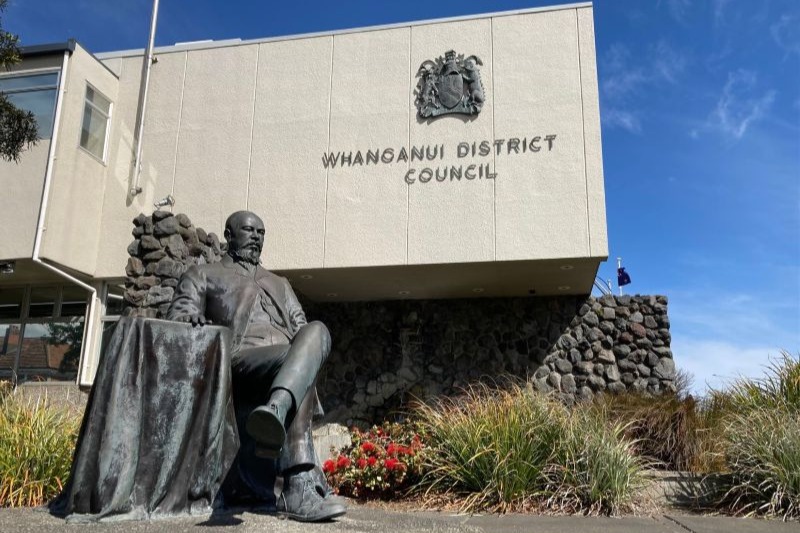
Ahead of the 2025 local elections, Black Pine invited the four mayoral candidates in our home city of Whanganui to answer three quick questions on urban design and architectural legacy. Responses were received from sitting councilors Josh Chandulal-Mackay and Peter Oskam, and current mayor Andrew Tripe.
Note: Responses have been lightly edited for clarity and format.
1. As a UNESCO City of Design, what will you do to improve the integration of housing, transport, and public services (e.g. parks, schools, hospitals) to make Whanganui a more liveable city?
Josh Chandulal-Mackay: During the next term of council a key piece of work will be the development of a spatial plan for Whanganui. This will sit over the top of key regulatory plans like Whanganui’s district plan and will consider how to achieve sustainable growth over the next several decades.
Central to this is making sure that growth takes into consideration proximity to green space, access to recreational activities, housing density, flood mitigation, and land availability across agricultural, industrial, commercial and residential development. It will consider access to public transport, cycleways, footpaths, parking and the other aspects of what makes a liveable community.
The role of the mayor will be to act as a champion for the process, and to lead the conversation with the community.
Peter Oskam: UNESCO City of Design is a defining feature for Whanganui. It gives us license to start with a clean slate in everything we do. To become more human-centred in our designs, this encompasses software, policies, processes, products and, architecturally, I feel this could play a big role in progressing Whanganui’s CBD.
I am not overly precious over some of our heritage buildings and good new design of building and city living with the interaction of visitors can be seen as our new heritage.
Andrew Tripe: Cut the red tape: make building consents faster, cheaper and easier, enabling much-needed housing for our community. Deliver more housing: set up a housing trust to build 1,000 houses over the next decade at no cost to the ratepayer. Plus make infill housing easier, and enable smaller blocks on peri-urban land as well as second-storey apartments on Victoria Ave.
2. How important to you is it that the council’s new housing entity eliminates fuel poverty and improves a sense of community for its residents?
JCM: It is essential that the new housing entity considers the needs of the tenants who’ll be the people most affected by new affordable housing developments. The two foremost priorities are security of tenancy and affordable rents, alongside access to social services, well-being support and broader community connection. Loneliness is a major cause of death for older people and it’s imperative that the new housing entity prioritises human-centred design to combat loneliness.
AT: Incredibly important. I have spoken to those people who live in social and community housing, and public transport and walking distance to shops and libraries is vital to their wellbeing. [As is] mixed tenancy: number of bedrooms, age of tenants, etc.
3. What is one architectural initiative you would champion as mayor that could leave a lasting legacy for Whanganui?
JCM: My policy platform is split into five key strands, one of them being ‘Whanganui as a Centre of Design & Culture’. As part of this strand, I am proposing to begin preliminary discussion with iwi about the development of a Te Awa Tupua Cultural Centre for Whanganui.
This is a long-term aspirational project that will require a long lead-in time and a Herculean fundraising effort, however it can build on the eco-cultural hub feasibility study already completed by the Regional Māori Tourism Organisation. The centre would celebrate Te Awa Tupua and would explore 600+ years of indigenous settlement along the banks of the Awa and how that history has woven and intermingled with colonial settlement post-1840.
AT: I have three!
- Retaining heritage and mixing heritage with modern.
- Floating River Amphitheatre: A performance and events stage that literally floats on the Whanganui River, linking culture and community with the awa.
- The Light of Whanganui: An iconic lighthouse-like structure at the river mouth, powered by renewable energy, symbolising guidance, resilience, and progress.
You can read more about each candidate and their policies on their campaign websites:
- Josh Chandulal-Mackay – www.joshformayor.co.nz
- Peter Oskam – www.oskamformayor.org
- Andrew Tripe – www.andrewtripeformayor.nz